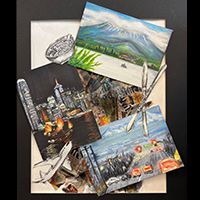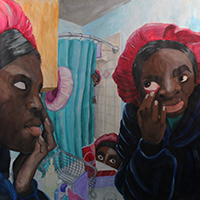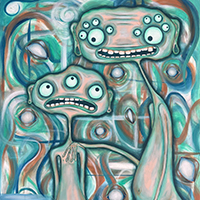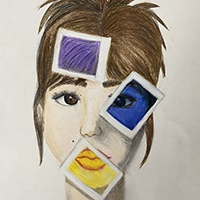
TRENDS - The Journal of the Texas Art Education Association
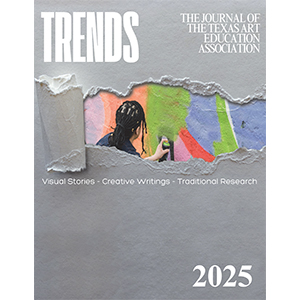
TAEA TRENDS - 2025
About TRENDS
TRENDS, The Journal of The Texas Art Education Association is published annually and is distributed to all TAEA members at our state conference.
The purpose of this peer-reviewed journal is to expand art education discourse by highlighting research, issues, and concerns that can inform our theoretical and pedagogical practices in and out of the classroom.
The viewpoints contained in TRENDS, The Journal of The Texas Art Education Association represent those of the writers and not the Texas Art Education Association. TAEA reserves the right to refuse any submissions based on questions regarding copyright, ethics and/ or inaccuracy. The co-editors reserve the right to edit copy for length without loss of integrity to submitted articles. Please refer to the "Author Guidelines" link for further clarification.
Current Call for Manuscripts for TRENDS 2026
Integrating Emerging Technologies into Art Education
The TRENDS 2026 Call for Manuscripts invites artists, educators, and researchers to address the complexities of how emerging technologies are being integrated into the teaching and learning of art. This issue will explore how new technologies including Artificial Intelligence are rapidly reshaping education and studio practice as teachers face the challenges that accompany them. This theme acknowledges the risk and reward of integrating emerging technologies into pedagogical practices as educators navigate how technology and machine intelligence coexist with human imagination.
New technologies can expand creative possibilities, personalize learning, and generate new ways of visualizing ideas. Yet, the presence of Artificial Intelligence in the classroom also raises critical questions: How do we remain authentic, maintain authorship, and keep our human voice? What happens when overreliance on generative tools stifles creative growth or diminishes the struggle necessary for authentic learning?
Submissions may address how emerging technologies are used to expand creative possibilities, provide new avenues for inquiry, or complicate notions of authorship and originality. Educators are invited to share classroom strategies, curricular frameworks, or research examining how new technologies can facilitate learning, critical thinking, and artmaking. Authors may also explore ethical, authentic, and creative dilemmas that accompany Artificial Intelligence, and how students interpret, question, or collaborate with technology in their artistic practice.
We encourage submissions that address how art educators:
- Integrate Artificial Intelligence tools into curriculum to enhance creativity, reflection, or visual literacy
- Support students in making ethical and authentic creative choices when using technology
- Encourage critical dialogue about authorship, originality, and ownership in digital creation
- Nurture student understanding and awareness of the differences between technology usage as a resource and reference
- Balance traditional media and digital experimentation to promote meaningful learning
- Facilitate reflection on the role of technology in shaping the future of art and design
Some questions you might consider are:
- How is technology transforming the way students conceptualize and produce art?
- In what ways can art educators design curricula that cultivate both digital fluency and creative agency?
- What ethical or philosophical considerations arise when integrating machine learning into creative practice?
- How can educators maintain authenticity, imagination, and critical inquiry in Artificial Intelligence-assisted classrooms?
- How might technology reshape the relationships among artist, audience, and artifact?
The editors invite manuscripts that examine practice, theory, and reflection on applications of emerging technologies in art education across all learning environments: K–12, higher education, museum, and community contexts.
Types of Submission
Visual images with minimal text accompanied by a 200-500-word description (descriptions may or may not be used, but are required), creative written submissions of between 1,000 - 2,000 words, traditional research manuscripts of up to 2,500 words, and book reviews related to the issue's theme.
Submissions must follow the 2026 TRENDS Author Guidelines listed below.
For questions or to request author guidelines, please contact .
TRENDS, The Journal of the Texas Art Education Association is a refereed professional journal, published annually by the Texas Art Education Association. The journal accepts articles written by authors residing both inside and outside of the state of Texas.
2026 Co-Editors

David Moya
Department Chair - Visual Arts & Humanities
Dallas College

Keri Reynolds, Ed.D.
Secondary Fine Art Lead
Alief ISD
Forms
2026 TRENDS Author Guidelines (Posted 10/22/2023)
TAEA Photo Release Form (Updated 10/22/2023)
TAEA Copyright Release Form (Updated 10/22/2023)
Accessing Past Issues of TRENDS
Dear readers, we are delighted that you can now access past issues of TRENDS. Click here to view past issues of TRENDS, beginning with March 1957. We are so grateful to Dr. Jack Davis for helping our organization have access to our legacy.
2026 TRENDS Author Guidelines for Submission of Manuscripts
Deadline
Original manuscripts must be received by May 1, 2026 as a Microsoft Word document, Pages document, or Google Doc link. Please review all information below and then use the button towards the bottom of this page to submit electronically. This annual journal will be published in November 2026.
We welcome arts-based submissions, creative written submissions, book reviews, as well as research articles.
Cover Page
All submissions should include a cover page that contains the following information for all 1st author and supporting authors:
- Title
- Type of submission (e.g., arts-based; creative; book review; research, other)
- Name of 1st author (corresponding author)
- Names of supporting authors
- Institutional affiliation of each author
- Mailing address for each author
- Phone number for each author
- E-mail address for each author
- Biographical statement for each author (approximately 100 words)
- You must also include a brief statement clarifying that your submission is not under consideration for publication elsewhere.
Abstract Page
All submissions should include an abstract page that contains the following information:
- Title
- Type of submission (e.g., arts-based; creative; book review; research, other)
- Abstract (75-150 words)
- Keywords (3)
- Number count of references listed (as appropriate)
Caption Page
See caption directions below and include this page if required
Specific Guidelines (based on submission type)
Arts-based submissions are primarily visual but might be accompanied by short texts that respond to the theme. Submissions should be accompanied by a 200-500 word contextual description (which might not be published but will be used to review the submission). Low resolution images are ok for review purposes, but please see image guidelines below to understand what is required for publication.
Creative written submissions should be between 1,000 - 2,000 words. We encourage including images. As above, low resolution images are fine for review, but carefully read the image guidelines below to understand publication requirements.
Book reviews should be 300-500 words. Reviews should provide a clear, concise description of the book. The book's thesis should be clearly defined. The review should position the book within relevant literature on the issue theme, and clearly demonstrate its contribution to the theme.
Research articles should be approximately 3,000 - 4,000 words in length and be written for a general audience who is knowledgeable about the practices of art education. Please avoid jargon and highly technical or specialized language. We welcome articles that explore the practice of art education from various contexts, such as schools, museums, community centers, libraries, and other informal or incidental learning ecologies.
General Guidelines for All Submissions
Preparation of Manuscripts
- Include the title of the article and page number in the top-right header of each page.
- Manuscripts must be formatted according to APA (7th Edition) standards.
- Use a 12-point font in Times New Roman or Arial.
- Double-space article and use 1-inch margins.
- We highly recommend that you have a professional colleague read and critique the article prior to submission. We will accept your submission based on the quality of the 1st submission.
- Do not include your name or any other identifying information within the manuscript (except for the cover page).
- All submissions will be blind reviewed and must be anonymous.
- Submit as a Word doc, a Pages doc, or a Google Doc.
Preparation of Illustrations
- Illustrations are encouraged for all submissions, whether as photographic documentation of events or as illustrations of artworks.
- If images are intended to illustrate your text, please insert low resolution thumbnails directly into the Word document for review purposes.
- If your images are intended as stand-alone art works (e.g., as part of a creative submission), please attach them to your email as .jpg files (approximately 1,000 pixels long or wide, and under 500K file size).
- All illustrations must have captions. If images are inserted into the text document you can provide a list of captions at the end of the document. If images are submitted as separate files, you must also submit a separate caption document.
- In the caption that correlates to each illustration, you must clarify that you have or can obtain publication right(s) to the image if it is accepted. Copyright laws prohibit the publication of images that you do not own or to which you have not secured explicit permissions.
- Upon acceptance, final images will need to be of publication quality and resolution (generally that means about 5MB file size at full-resolution pixel dimensions).
- Additionally, images to be published must be accompanied by a photo release, and if the image is owned by someone else, a copyright release form.
- Photo Release Form (link above under Forms)
- Copyright Release Form (link above under Forms)
Submission
Click the buttom below to submit your cover page, abstract, and caption page (if needed) in one digital file. Submit images in this same email as separate files following directions above. Also include the Photo Release Form and Copyright Release Form.
If you have any questions, please email .
Review Procedures
All submissions will be blind reviewed.
Most manuscripts are accepted on the basis of the quality of the first submission. Some manuscripts may be asked for at least one round of revisions.
The co-editors reserve the right to edit articles for length.
TAEA reserves the right to refuse submissions based on copyright, ethics, and / or inaccuracies.
TRENDS, The Journal of the Texas Art Education Association, is a refereed professional journal, published annually by the Texas Art Education Association. The journal accepts articles written by authors residing both inside and outside of the state of Texas.
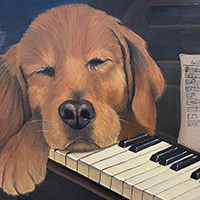
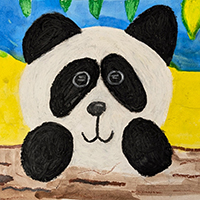
Highlights from 2025-2026 Student Programs
Click any image to see more information about the artwork.